
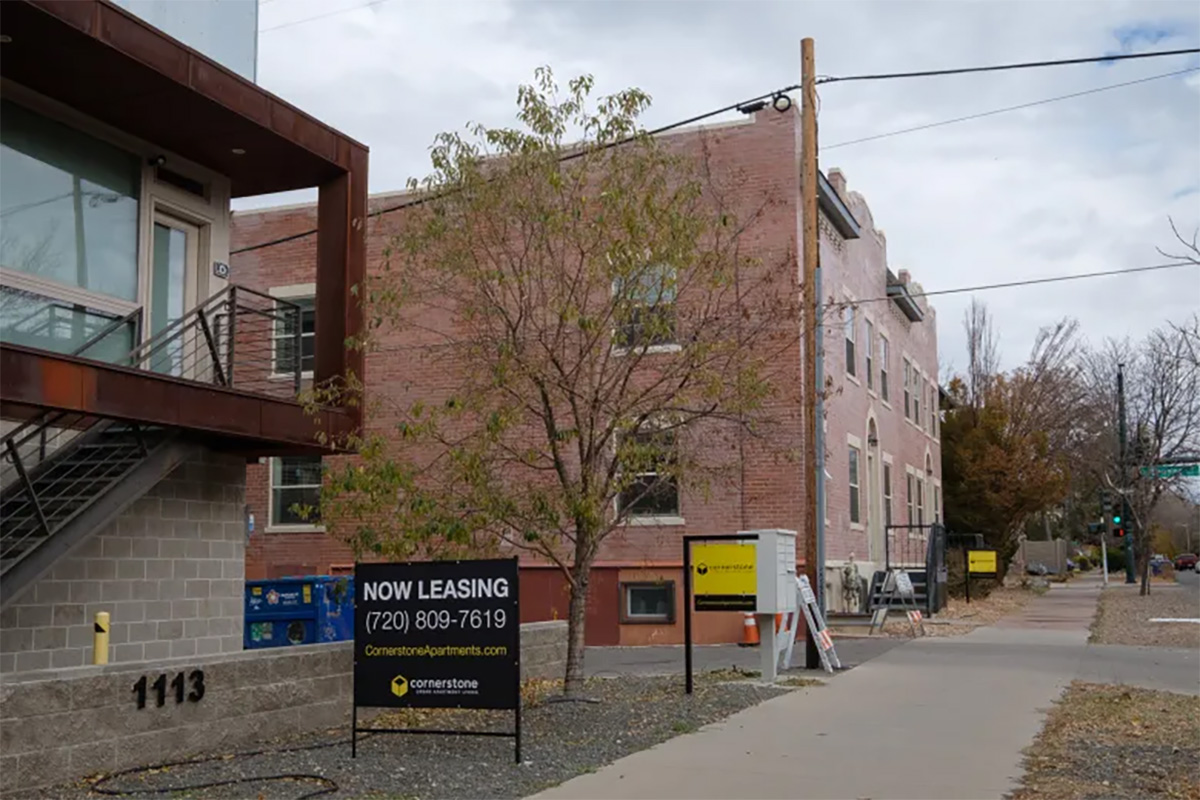
With free months and other concessions, Denver’s rents may be falling faster than the industry data shows. But not everyone is seeing lower rents.
When Lauren Harris started apartment hunting in June, there were so many special deals that she needed a spreadsheet to keep track of them. She wound up with an incredible bargain on a new place in North Capitol Hill: three months of free rent.
There’s more.
The two-bedroom unit has its own washer and dryer and a second bathroom, unlike her old place, which was very noisy and very dated but the best-priced option when she was searching back in 2024. The new place is in a modern, 200-plus unit complex, with a gym, a rooftop lounge and a spa for residents and their pets. It’s quiet and feels safer. She split the free rent over a 14-month lease and pays about the same amount as before: $1,850 a month.
“The price of the unit itself was much less than it normally was, so much so that the leasing agent said that she had to run the numbers three times because she thought it was a mistake,” said Harris, who usually shuns big complexes but those concessions! “It turned out great.”
And it’s become the norm in Denver these days, where cash bonuses, ski pass giveaways, annual museum memberships and up to three months of free rent have pushed concessions offered by apartments to a 15-year high, according to the local apartment association.
But what may make Harris a little unique is that she enjoys looking at apartment listings as “a hobby.” So she was tuned into the rental market and knew that thousands of new apartments had opened in Denver, leading to an increase in vacancies and lower rents. And she knows not all renters are benefitting.
“I know someone who lives in my same building and he’s not happy because he’s paying the same amount of money for a studio,” that she’s paying for a two-bedroom, Harris said. “He signed a year-and-a-half ago. … He did not do his due diligence of looking around. It was just easier for him to renew.”
Harris’ stats — and her neighbor’s — are captured in the third-quarter report from the Apartment Association of Metro Denver, which noted last month that average rents have fallen 5% in a year, to $1,816, the lowest in three years.
But that’s just the average rent.
Rents may be falling faster
Concessions aren’t counted in the industry’s average rent data. Add those in and you get what the industry calls “effective rent,” which was not just lower in the third quarter but dropped at a rate of 9.4% in a year to $1,709.
The number may even be “well below $1,700,” said Mark Williams, the association’s executive vice president, citing the “highly competitive housing market within the last 60-90 days.”
Concessions are offered even in strong market conditions, he said in an email, because new buildings need to fill up fast to keep owners happy and to help pay down high-interest real estate loans.
“The bottom line is that housing providers target an occupancy level around 95%, and adjust rents and discounts to keep occupancy in the mid-90 percent,” Williams said.
In Denver’s Golden Triangle neighborhood, the 192-unit Art Studios had nearly 50 available apartments on Sunday, according to the apartment’s website. That’s a 75% occupancy rate.
Developers from Nichols Partnership acquired the former Art Institute of Colorado in 2019, before the pandemic, after seeing success in converting other properties-turned-studio apartments. When it opened in late 2023, Art Studios was “the best value apartment in town,” said Robbie Nichols, a project manager and partner at Nichols.
The lowest-priced studio, at 276 square feet, is $1,099 and offers up to 10 weeks free on a 15-month lease, plus a free membership to a local museum. But it’s competing with larger studios at other new properties with similar concessions. That’s made it extra challenging.
“Now with rate compression everyone is getting aggressive both on rate and concessions and we’re still all in a high interest rate environment. So rent revenue is decreasing across the board but debt service is still very high,” Nichols said in an email. But as the pipeline for new apartment buildings shrinks into 2027, he expects “demand will catch up and rents will stabilize, so it’s a matter of finding a solution to keep your property sustainable in the meantime.”
In the past three years, more than 55,000 units were added to the Denver metro region, which now has nearly 450,000 units overall. That’s had a negative effect on occupancy rates, and pushed vacancy rates in some cities to more than 12% at apartments built this decade.
Denver’s just catching up from years of a housing shortage, said Scott Rathbun, president of Apartment Insights, which handles rental data for the apartment association.
Rathbun estimates that there are still 26,500 units currently under construction with another 51,300 planned.
“The pipeline does sound big, especially when you consider the total number of apartments in the Denver Metro Area (of all sizes) is currently estimated to just under 450,000 total units,” he said in an email. But, he added, “I don’t believe the units in the pipeline would be enough to fill the entire gap according to housing needs studies.”
Before the pandemic, Colorado’s housing shortage peaked at 140,000 units. To meet the need of new residents, the state would need to add 34,100 new homes a year — and not second homes or vacation homes. The latest data shows the gap shrunk to 106,000 units, according to the State Demography Office.
Many have been built so the pipeline has shrunk. A year ago, 57,000 apartment units were planned. And not all projects move forward, even after getting approved. Next year will be interesting, he said, as other economic factors like slowing job and population growth impact development.
“On the other hand, if demand falls because people stop moving to Denver or we have a recession (or both) then we might be delivering just the right number of units or even too many units moving forward,” Rathbun said. “I think this scenario is very unlikely because demand would have to fall off a cliff before this would come to fruition.”
Older properties have lower rents
There are other reasons rents are lower than in the report. The association’s report only tracks 76% of the apartments in the seven-county metro Denver region. Affordable housing, student housing and independent age-restricted properties are excluded.
It also skips properties with fewer than 50 units because it’s difficult to track down owners.
But that eliminates many of the 321 apartment buildings managed by Cornerstone Apartment Services, the company behind the prolific yellow for-rent signs dotting Denver’s urban core. Their rents are lower.
“I just got our monthly report and our average rent across our portfolio is $1,403,” said Jim Lorenzen, Cornerstone’s president and founder. “We’re $400 less. That’s pretty significant on a percentage basis. And I think it’s affordable.”
In fact, based on a Colorado anti-discrimination rent law passed in 2023 that requires landlords to accept applicants who earn twice their monthly rent — and not the oft-suggested three times — that makes Cornerstone’s average rent feasible for folks earning at least $33,672 a year, or $16.19 an hour. That’s less than Denver’s minimum wage of $18.81.
Many of Cornerstone’s nearly 7,900 apartments are older and smaller and in buildings that average 22 units. While the company does manage some properties built this decade, most are “vintage,” as the industry calls older buildings like those built before the 1970s.
The 12-unit Regina Apartments, built in 1952, is three blocks north of Denver Botanic Gardens. A two-bedroom, one-bath rental is surprisingly quiet near the window, where traffic zooms by on Josephine Street. “Double-pane windows,” Lorenzen said. “We do it for both energy savings and also from a maintenance standpoint. But it also cuts down on noise.”
The 815-square-foot apartment is clean and charming, with hardwood floors, updated stainless steel appliances, a gas stove and a hidden dishwasher. The single bathroom has two sinks and heated floors. While one must trudge to the basement to do laundry, at least it’s free. The apartment has been available for about five weeks.
“We just dropped the rents again,” Lorenzen said, during a tour last week. “This unit, you can rent for $1,630. It was renting for $2,200 so that’s a big drop.”
The new lower rate is available with a 18-month lease for those who sign before Thanksgiving. Otherwise, it’s still $2,200 on a 6-month lease and move-in date in the first week of December. There’s also one free month’s rent and if you tour the space and sign a lease within 48 hours, Cornerstone is offering a $500 bonus off rent — effectively lowering the rent to $1,512 a month.
“Why would a place like this be sitting around? It’s the market,” said Sinai Bebo, Cornerstone’s leasing manager. “With the volume of new construction, someone who can afford $2,100 to rent here can now afford to rent something in a different building with concessions and the push that (other apartments) are doing. We want to stay competitive.”
The lower rent is apparently working. As of Wednesday, the Regina was fully leased.
A renters’ market for those paying attention
The El Cortez, just blocks from the State Capitol, is the epitome of vintage apartments. The brick building, built in 1928 with a nod to Romanesque Revival style, has dimly-lit hallways covered in burgundy floral carpet. There are radiators for heat; fans and windows for cooling. Most of the 32 units are 350-square foot studios and do have updated kitchens and bathrooms. A limited number of off-street parking spots are available for a fee.
Cornerstone manages the property and offers a studio for as little as $895 a month with a 18-month lease. There’s also a six-month lease for $1,295.
In either scenario, an eligible tenant needs to make between $10.39 and $14.94 an hour to qualify. And that’s not counting the free month of rent or “look-and-lease” deal to get another $500 discount. That puts the lowest effective rent at $817.50 a month.



An interesting look at how Denver rent “declines” can be a little misleading once you factor in concessions like free months—on paper the numbers soften, but the real story is how owners are using perks and short-term solutions to keep units filled. It reminds me of how, in other parts of property and site management, flexibility matters just as much as the headline rate—whether that’s setting up a temporary kitchen during renovations or relying on basic support services in remote areas (like the shower trailer options available around Cameron, AZ) when normal infrastructure isn’t practical. Holiday greetings, and thanks for sharing a thoughtful breakdown of the data.